The Robot Arm: How a Simple Machine Is Reshaping Modern Industry
 admin
adminFrom car factories to surgical operating rooms, the robot arm has quietly become one of the most transformative machines of the last fifty years. What started as a clunky, single-purpose welding tool on Detroit assembly lines is now a precise, sensor-driven partner working alongside humans in warehouses, hospitals, and even our homes. This article breaks down what a robot arm actually is, how it works, where it's used, and where the technology is headed.
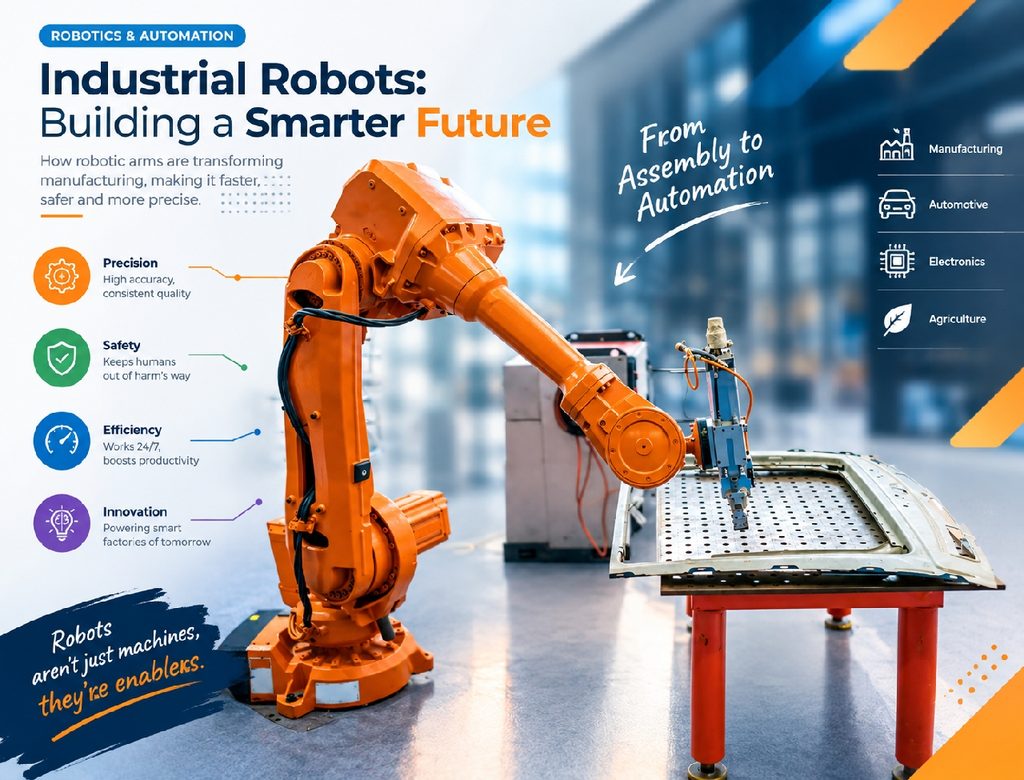
What Is a Robot Arm?
A robot arm (also called a robotic manipulator) is a programmable mechanical arm designed to mimic the movement and function of a human arm. It typically consists of several rigid segments connected by joints, powered by motors or hydraulic/pneumatic actuators, and controlled by a computer system. At the end of the arm sits an "end effector" — the tool that actually does the work, such as a gripper, welding torch, spray gun, or surgical instrument.
Most industrial robot arms have between four and seven degrees of freedom (axes of movement), which allows them to reach, rotate, and orient objects with a level of precision far beyond human capability.
How Robot Arms Work
A robot arm operates through three core systems working together:
- Mechanical structure — the joints, links, and actuators that physically move the arm.
- Sensors — devices like encoders, force sensors, and cameras that give the robot feedback on position, pressure, and its surrounding environment.
- Control system — the "brain" that interprets programming instructions and sensor data to move the arm accurately and safely.
Engineers typically program robot arms in one of two ways: through direct coding using specialized robotics languages, or through "teach pendant" programming, where a technician physically guides the arm through a task and the controller records the motion path for repetition.
Common Types of Robot Arms
- Articulated arms — the most common type, resembling a human arm with rotary joints; used widely in welding, painting, and assembly.
- SCARA arms — Selective Compliance Articulated Robot Arms, ideal for fast, precise pick-and-place work on a horizontal plane.
- Delta (parallel) arms — spider-like robots known for extremely high speed, often seen in food packaging and sorting.
- Cartesian arms — move along straight X, Y, and Z axes, favored for 3D printing and CNC-style applications.
- Collaborative robots (cobots) — lightweight arms built with safety sensors so they can work directly alongside humans without protective cages.
Where Robot Arms Are Used Today
- Manufacturing — welding, painting, assembly, and material handling remain the backbone of industrial robotics.
- Logistics and warehousing — robot arms sort, pick, and pack products in fulfillment centers, often working alongside autonomous mobile robots.
- Healthcare — surgical robot arms enable minimally invasive procedures with greater precision and smaller incisions than manual surgery.
- Agriculture — robotic arms are increasingly used for fruit picking and crop monitoring.
- Consumer and education — smaller, affordable robot arm kits are now used in schools and hobbyist projects to teach robotics and coding.
Benefits of Using Robot Arms
- Consistency and precision — robots repeat the same motion with minimal variation, improving product quality.
- Increased productivity — robot arms can operate continuously without fatigue, increasing throughput.
- Improved workplace safety — robots take over dangerous, repetitive, or physically demanding tasks, reducing injury risk for human workers.
- Cost efficiency over time — while the upfront investment can be significant, reduced waste, fewer errors, and lower labor costs often deliver a strong long-term return.
Challenges and Limitations
Robot arms aren't a perfect solution for every task. High upfront costs, the need for skilled programming and maintenance, and difficulty adapting to highly variable or unstructured environments remain real barriers — especially for small and medium-sized businesses. Integration with existing production lines can also require significant engineering work.
The Future of Robot Arms
Artificial intelligence is rapidly changing what robot arms can do. Machine learning enables arms to recognize objects, adapt to unexpected obstacles, and even learn new tasks from demonstration rather than explicit programming. Combined with advances in computer vision and tactile sensing, next-generation robot arms are expected to handle far more complex, less predictable tasks — from sorting mixed recycling to assisting in elder care.
As costs continue to fall and cobots become easier to deploy, robot arms are moving beyond large factories and into small businesses, labs, and even homes, marking the next phase in the democratization of automation.
Final Thoughts
The robot arm has evolved from a single-purpose industrial tool into a versatile, intelligent machine driving innovation across nearly every sector. Whether you're exploring automation for a growing business or simply curious about the technology shaping the future of work, understanding how robot arms function — and where they're headed — offers a valuable window into the next industrial revolution.