Robots That Finally Understand What You're Saying (And Do Something About It)
 admin
admin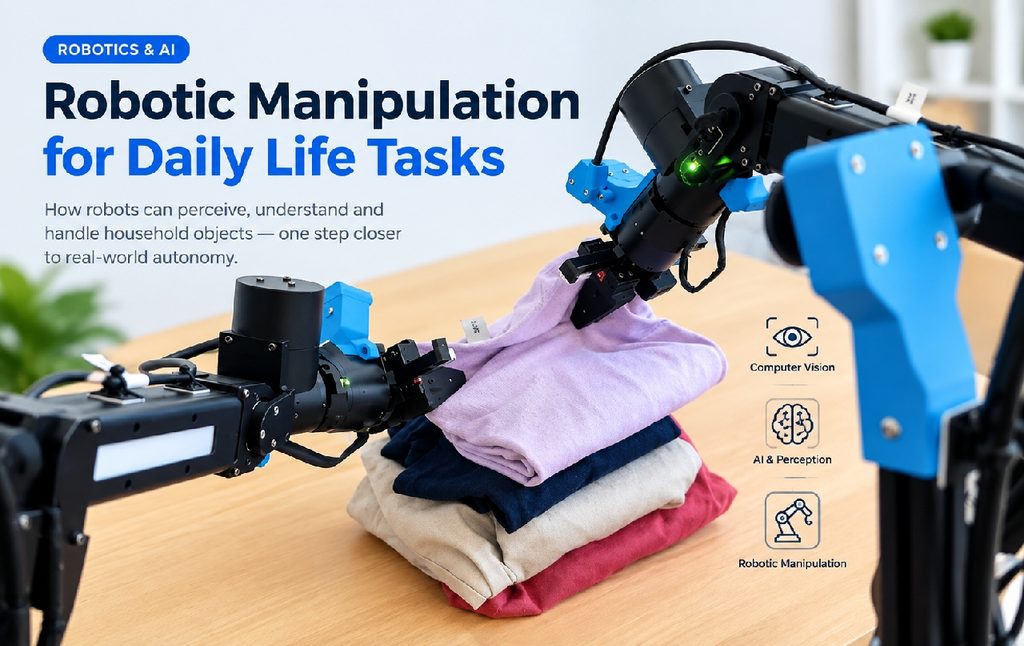
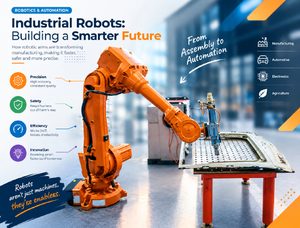
For decades, robots were brilliant at exactly one thing and useless at everything else. Give a factory arm the same weld to make ten thousand times a day, and it'll do it flawlessly. Ask it to instead pick up a mug it's never seen, sitting somewhere it's never looked, because you asked in plain English — and it has no idea what you're talking about. That gap, between narrow mechanical precision and broad human-like understanding, has been the central frustration of robotics for a very long time.
Vision-Language-Action models, or VLAs, are the current best attempt at closing it.
So what is a VLA, actually?
Strip away the jargon and the idea is almost stubbornly simple: take a model that can see, a model that can understand language, and fuse them with a system that can move a physical body — and train the whole thing together, end to end, instead of stitching three separate programs together with duct tape.
A VLA typically takes in three things at once: a camera image of whatever's in front of the robot, a plain-language instruction like "put the red block in the box," and some sense of the robot's own current state — where its joints are, what its gripper is doing. It fuses all of that into one representation and outputs a sequence of motor commands that (ideally) accomplish the task.
The lineage is pretty visible if you look at the names: RT-1 and RT-2 out of Google DeepMind, OpenVLA as an open alternative anyone could build on, Octo as a generalist policy trained across robot types, and the π0 (pi-zero) family from Physical Intelligence, which paired a vision-language backbone with a separate "action expert" for producing smooth, continuous movement rather than jerky discrete steps. Each generation has chipped away at the same problem from a slightly different angle.
Why language, specifically?
It's tempting to think the "language" part of VLA is just a nice-to-have — a way to type commands instead of writing code. It's actually doing something much more load-bearing than that.
Language is how these models inherit the internet's common sense. A model that's spent its pretraining life reading about kitchens, tools, and how objects relate to each other arrives at robotics already knowing that a "mug" is graspable, that "fragile" things need a gentler grip, and that "the one next to the plate" refers to position, not identity. None of that had to be hand-coded. It's borrowed, essentially for free, from the same large-scale pretraining that made chatbots good at conversation — and it's a big part of why VLAs generalize to objects and phrasings they've never explicitly been trained on, in a way that older, narrower robotic controllers never could.
How the pieces actually connect
Under the hood, most current VLAs follow a recognizable shape. A visual encoder turns the camera feed into a compact representation. A text encoder does the same for the instruction. Those get fed into a large language-model backbone that fuses everything into a shared understanding of "what's being asked, in this scene, right now." Then an action decoder — sometimes an autoregressive head predicting discrete action tokens, sometimes a diffusion or flow-matching module generating continuous trajectories — turns that understanding into an actual sequence of joint movements.
That second part matters more than it might sound. Discrete-token approaches are simpler but can produce choppier motion. Diffusion and flow-matching approaches, the kind used in the π0 line and its successors, tend to produce smoother, more human-like movement, which turns out to matter a great deal when the task involves anything delicate — pouring, folding, handling something that could tip over.
Where this is actually showing up
This isn't purely an academic exercise anymore. Warehouse automation is an obvious early adopter, since picking arbitrary items off arbitrary shelves is exactly the kind of "long tail" problem VLAs are built for. Humanoid robotics companies are leaning on the same approach to get general-purpose home and factory robots off the ground faster than task-by-task programming ever could. There's even movement into more safety-critical territory like surgical assistance, though that comes with a correspondingly higher bar for reliability.
None of this is close to solved, though. Getting a VLA to work in simulation is one thing; getting it to survive contact with a real, cluttered, unpredictable room is another. A lot of current engineering effort — sometimes bundled under names like RobOps — goes into exactly that gap: monitoring robots in deployment, catching mechanical wear or control instability before it becomes a failure, and rigorously testing model updates in simulation before anything gets near real hardware.
The honest caveats
A few things are worth saying plainly, because the hype around this space tends to outrun it.
First, data is the real bottleneck, more so than architecture at this point. Training a generalist robot policy requires enormous amounts of real-world demonstration data, and collecting that is slow, expensive, and physical in a way that scraping text from the internet simply isn't. A growing chunk of the research world has quietly shifted its attention toward "data engines" and benchmarks rather than new model architectures, on the theory that better data will move the needle further than a cleverer network will.
Second, a VLA alone doesn't necessarily know how to plan several steps ahead or reason about a task's structure the way a person naturally does — it's often paired with a broader world model or planning layer to handle judgment calls that go beyond immediate perception-to-action mapping.
Third, running these things is not lightweight. A large vision-language backbone plus a real-time action decoder has to run fast enough to control a physical body without lag, on hardware that fits inside or beside a robot rather than in a data center — which has spurred its own subfield of squeezing these models onto smaller, cheaper chips without losing too much capability.
Where it's heading
The trajectory is fairly clear even if the timeline isn't: fewer bespoke, task-specific robot programs, and more general-purpose models that can be told what to do rather than painstakingly programmed for it — the same shift text-based AI went through, just with a much higher cost of failure, since a bad output here can knock something off a shelf instead of just being a wrong answer on a screen.
It's not going to make dedicated industrial robots obsolete — a precision weld still wants a precision-welding machine. But for everything in the long tail of "pick this specific, unusual thing up and do something reasonable with it," VLAs are quickly becoming the default answer, and the pace of new models, benchmarks, and real deployments over just the past year suggests that answer is only going to get more capable from here.